- Recipes
- Salmon and Cucumber Hosomaki
Salmon and Cucumber Hosomaki

Ingredients
Step by step process
Preparing Sushi Rice
- 1
Place the sushi rice in a fine-mesh sieve and rinse thoroughly under cold running water until the water runs clear, usually 4-5 rinses. Well-rinsed, perfectly cooked rice is the foundation of every great cucumber hosomaki.
- 2
Move the rinsed rice into a pot and pour in 360 ml of cold water. Let it soak for 10 minutes. Then cover with a lid, bring to a boil and immediately reduce to the lowest heat setting. Cook for 12-15 minutes until all the water is absorbed - do not lift the lid.
TIP:Rinse the rice thoroughly until the water runs clear. Pour water in a ratio of 1:1.3-1.5. Let it rest for 10-15 minutes, then bring it to a boil. Cook on the lowest heat with a lid on, never lift the lid. It's done when the water has evaporated.
- 3
Meanwhile, gently warm the rice vinegar with the sugar and salt in a small saucepan, stirring until fully dissolved. The mixture must not boil, just warm it through.
- 4
Transfer the cooked rice to a wide bowl, pour over the vinegar dressing and gently fold with a wooden spatula using cutting motions. Do not press or stir in circles, keep the grains intact.
TIP:Stir the rice with cutting motions (lifting from the bottom and turning), not in circular motions, to prevent the grains from breaking. As it cools, fan it with a plate or fan for a silky sheen without stickiness.
- 5
While folding, fan the rice (using a plate or fan) to help it cool faster and develop its characteristic silky sheen. Cover with a damp cloth and leave to cool to room temperature.
Preparing the Filling
- 6
Cut the salmon. With a sharp knife, slice it into thin strips roughly 8-10 cm long and 1 cm wide, drawing the blade toward you in one smooth stroke rather than sawing back and forth. This keeps the cut clean and prevents the fish from crumbling.
TIP:Cut fish with a sharp knife (15-20 cm) using one smooth stroke, not a sawing motion which damages the meat. The blade must be well-honed. Chill the fish and cut on a dry board to make the work easier.
- 7
Wash the cucumber, trim the ends and cut into thin long batons of similar dimensions to the salmon. If the cucumber contains a lot of seeds, scrape them out with a spoon first and use only the firm flesh.
Rolling the Hosomaki
- 8
Cut each nori sheet in half lengthwise with scissors, from one sheet you get two half-sheets, giving you 8 pieces in total for 8 rolls.
- 9
Place one half-sheet of nori on the bamboo mat (makisu) shiny side down and rough side up, with the longer edge facing toward you.
- 10
Wet your hands with water to prevent the rice from sticking, and evenly spread a thin layer of sushi rice over the entire surface of the nori. Leave about 1 cm of bare nori at the top, this will be used to seal the roll.
- 11
If using wasabi, spread a very thin strip across the center of the rice using your fingertip.
- 12
Place 1-2 strips of salmon or cucumber in the center of the rice. One filling per roll is enough to keep the hosomaki nicely slim and compact.
- 13
Using the bamboo mat, begin rolling from the bottom edge toward the bare strip of nori. Roll firmly but carefully, the roll should be tight, but not over-compressed, so the filling doesn't deform.
- 14
Lightly moisten the bare edge of the nori with a damp fingertip, roll all the way to the end and press firmly for a few seconds so the nori seals and the roll holds together.
- 15
Roll the remaining half-sheets in the same way, alternating between salmon and cucumber filling as desired.
Serving
- 16
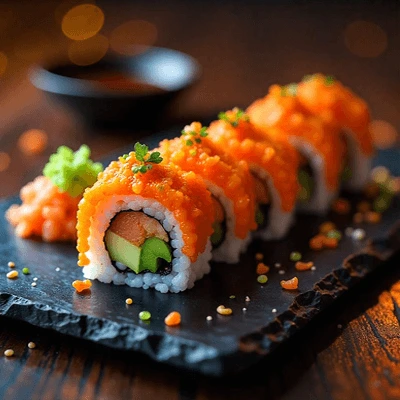
Using a sharp, dampened knife, cut each roll into 6 equal pieces. Wipe and re-wet the blade between each cut to keep the cuts clean and prevent the rolls from deforming.
- 17
Arrange the hosomaki on a plate cut side up, and serve with soy sauce in a dipping bowl, pickled ginger and wasabi on the side.
More tips:
The quality of the fish is crucial for hosomaki, always buy sashimi-grade salmon intended for direct consumption, ideally from a trusted fishmonger or specialist shop.
You can wrap the bamboo rolling mat (makisu) in cling film, it makes cleaning easier and prevents rice from sticking to it.


Similar recipes


Topic: Japanese Cuisine

Summer tomatoes in the leading role: recipes, tips, and inspiration for their use
Summer tomatoes are among the tastiest seasonal ingredients. Get inspired by recipes, tips, and ideas for their use in salads, sauces, soups, and homemade preserves.